

About Us | Visual Tools | Thinking Maps® | Resources | Research | Home

Thinking Maps - A Language for Learning
 Thinking Maps® were developed as a language for learning in 1988 by Dr. David Hyerle. There are eight maps in this language that are used by teachers and students (K-12; pre-K; adult education, university and business) for reading comprehension, writing process problem solving, and thinking skills improvement. Through quality training, materials and support services, Designs for Thinking will support learning communities with the tools necessary to become successful thinkers, problem solvers, decision makers, and ultimately, lifelong learners. Thousands of whole schools from across the United States have received in-depth training and follow-up using Thinking Maps. Internationally, Thinking Maps are also being used and promoted in Canada, the United Kingdom, Australia, New Zealand, Brazil, Egypt, Ethiopia and other countries.
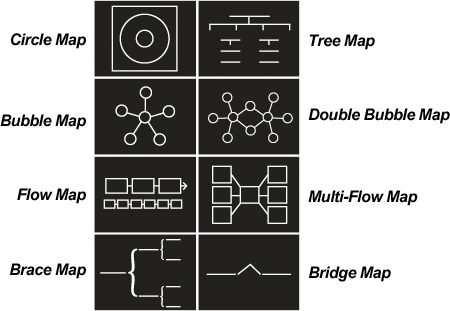
 Each of the eight Thinking Maps is based on a fundamental cognitive skill such as comparing and contrasting, sequencing, classifying, and cause-effect reasoning. Much like carpenters using a set of tools, multiple Thinking Maps are used as a eight maps icon toolkit by students for constructing knowledge: for improving the basics of reading, writing, and mathematics as well as for problem-solving and the development of higher-order thinking abilities. A wealth of research and published articles supports the use of different types of Visual Tools generally, and Thinking Maps specifically. New brain research provides even greater insights into why most students perform better when using Thinking Maps.
Benefits:
- Students learn more effectively and more efficiently
- Objectives are covered in less time with greater retention
- Thought processes are represented similarly throughout the curricula
- Schools also promote integrated thinking and interdisciplinary learning
- Teachers can easily gauge student knowledge prior to a specific lesson
- Student performance can be tracked accurately over time
- Students gain effective tools to use across their academic and working careers
- Lifelong thinking tools
What researchers, school leaders, students and other educational leaders are saying about visual tools and Thinking Maps:
Pat Wolfe
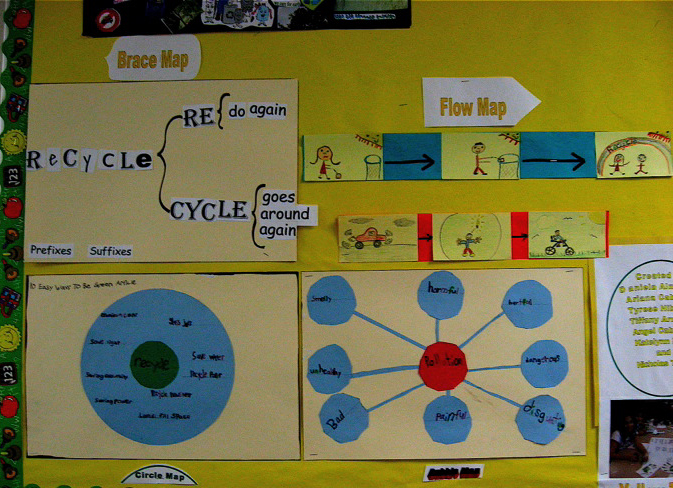 "Neuroscienteist tell us that the brain organizes information in networks and maps."
Robert Marzano, Ph.D.
"Knowledge is stored in two forms: linguistic and nonlinguistically. Research proves that the more we use both systems of representation the better we are able to think and recall knowledge."
Art Costa, Ph.D.
"School is a home for the mind"
Thomasina DePinto, Ph.D.
"Thinking Maps is within the reach of any school, replicable, and may refine and even reframe reading and writing instruction"
Thinking in Great Britain
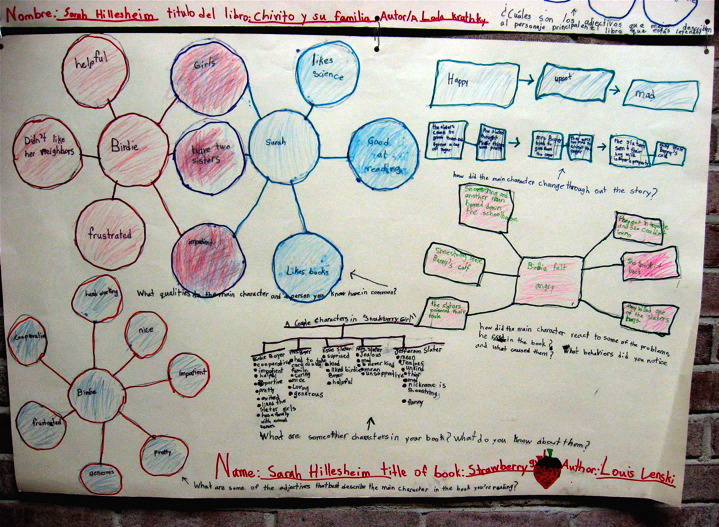 "I'm able to think easier... [Thinking Maps] make things clearer... ...I get more between the lines..."
Yvette Jackson, Ed.D.
"...we provide tools that enable teachers to build on the capacity of the students to think critically through instruction..."
Estee Lopez, Ed.D.
...the research tells us we are at risk... the largest minority group in our nation...
...to make sure they are great thinkers, major contributors, articulate, and capable...
...because of the visual nature of Thinking Maps the children quickly grasped the concepts behind each of the maps...
...the teachers began to look at these children differently...
...challenged their thinking... awakened their curiosity...
Thinking Maps - Whole School Change
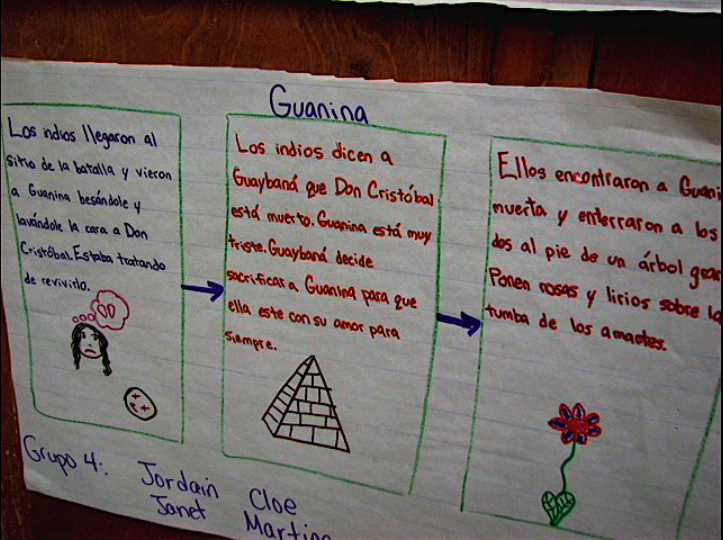 Professional development training focuses primarily on whole school and feeder pattern training, so that students and teachers have continuous use of these tools over multiple years. Capacity Building, Training of Trainers, and optional multi-year follow-up are different formats for supporting long term change.
Training for a whole school requires training materials, 6 hours of workshop training, and two follow-up days. These follow-up days often include demonstration lessons, curriculum design, constructive feedback, and Mapping the Standards use of Thinking Maps Software.
Student Thinking Maps
Click play to watch a slide show of student generated Thinking Maps from schools across New Rochelle, New York Public School District.
If the above slide show is not playing
download free Quicktime Player (Win & Mac)
Click here to watch a larger version of the New Rochelle Student Thinking Maps slideshow.
Assistant Superintendent, New Rochelle School District, New York
...Thinking Maps have proved to be an important initiative in our district...
...provides our teachers and students with a means to organize their thoughts and to be able to analyze and present their ideas...
...particularly important in a district of our diversity...
...regardless of English proficiency... contribute to the overall classroom discourse...
Thinking Maps Research
Read more about research on visual tools, Thinking Schools, and Thinking Maps including books, dissertations, case studies, documentary films and more. Many links can be found in the research section here on the Designs for Thinking website. S
go to the research pages MAPS]
Thinking Maps Resources: Software, Books, Online Courses, Video and more
Excellent resources for Thinking Maps may be found in the resources section here on the Designs for Thinking website. This includes previews of books, online courses, video and more.
go to resources
Thinking Maps Overview
The following video (excerpt from Visual Tools for Literacy Online Course) provides an overview of Thinking Maps®. Hear David Hyerle on a Quicktime Movie. If you don't have Quicktime, download the free Quicktime Player.
Developing Connective Leadership
Successes With Thinking Maps®
Larry Alper, David Hyerle, Kimberly Williams, Authors
Solution Tree Press, 2012
"If our best thinking comes by making connections and building patterns, then what would these patterns look like, and what might they be based on?"—ask the authors. Most importantly, how could they be used?
Developing Connective Leadership shows you how Thinking Maps® are an efficient and eloquent language that can be used to explore and reveal ideas, thought processes, and intentions. By creating visual representations of thought, leaders create shared understandings and foster connections among staff.
Explore how schools have used the Thinking Maps® process to create strong collaborative bonds and facilitate shared leadership. As staff members collaborate to construct a shared frame of reference, they are empowered to execute and sustain the school's vision.
Benefits:
- Offers real-life experiences from school leaders using Thinking Maps® for professional development
- Identifies eight Thinking Maps® used to build connective leadership practices
- Suggests how Thinking Maps® can be used to reformulate and reconstruct negative or damaging frames of reference
- Discusses how Thinking Maps® can energize and inspire insight and solutions
