About Us | Visual Tools | Thinking Maps® | Resources | Research | Home

David Hyerle and Larry Alper, Editors
Second Edition, Corwin Press, January 2011
Research Highlights from Student Successes With Thinking Maps
Click here (pdf file) to download Research Highlights from
Student Successes With Thinking Maps
About the Book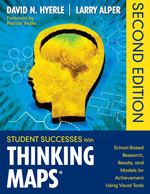
Excerpt from Forward by Pat Wolfe
The brain remembers what it has seen because humans are intrinsically visual beings. The eyes contain almost 70% of the body’s sensory receptors and send millions of signals every second along optic nerves to the visual processing centers of the brain…
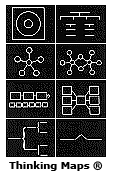
The Thinking Maps® program takes full advantage of the natural proclivity of the brain to see and think visually. The authors describe Thinking Maps as a language of visual tools grounded in the thinking process, a most neurally apt description. Neuroscientists tell us that the brain organizes information in networks and maps. What better way to teach students to think about ideas and organize and express their ideas than to use the very same method that the brain uses.
This book provides an invaluable way to help our students truly understand and retain the concepts behind the facts, and to do this in an exciting and motivating way.
 Pat Wolfe, Author, Building the Reading Brain
More About the Book
Excerpt from Forward by Marti Richardson, President, NSDC
All students and staff members should have high quality learning on a daily basis. Student Successes with Thinking Maps® examines a series of vignettes which breathe life into this statement, presents a powerful argument for using this tool at every level, and illustrates how students have systematically and deliberately taken charge of their own learning via the transformational power of Thinking Maps. Following a presentation of the “what, why, and how” of Thinking Maps, the reader is treated to a panoramic view into schools that have successfully used this unique tool kit to bridge the gap from research to practice. All are worthy models to examine—and follow—as schools focus on continuous growth for all through individual and school improvement. The book is a must read!
 Marti Richardson