


 Student Successes With Thinking Maps
David Hyerle, Editor
with Sarah Curtis and Larry Alper coeditors
Chapter 6: Maps for the Road to Reading Comprehension: Bridging Reading Text Structures to Writing Prompts
Thomasina DePinto Piercy, Ph.D. and David Hyerle, Ed.D.
‘Thinking Maps are the paper of my mind.’
First Grade Student
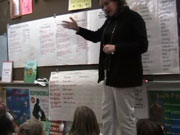
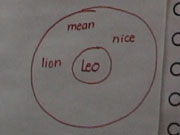
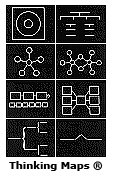
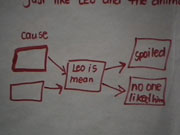
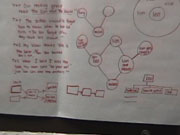
‘The discussion among Ms. Smith and her students is within reach of any school, replicable, and may refine and even reframe reading and writing instruction, and even offer a new direction for cognitive science research. This teacher had brought students to such a high level of fluency with thinking maps that they could begin to identify text patterns on their own. They were able to use fundamental thinking skills vocabulary (describing, compare, causes, etc.) and respective cognitive maps (bubble, double bubble, multi-flow, etc.) and had the metacognitive awareness of being able to explicitly transfer these processes and tools to reading comprehension through identifying text structures. They were then able to return to their seats with blank sheets of paper and, with varying results, choose a thinking map and expand their thinking. They later went on to write about the story using the maps they had chosen to organize their ideas.
This sample of classroom activity is a practical and symbolic representation of a new form of literacy and a transformation of how we perceive the interrelationships between thinking patterns and the fundamentals of reading comprehension.
In addition, the No Child Left Behind legislation requires that each state test content knowledge and how well students perform. Maryland meets this requirement by using the new 2003 Maryland School Assessments. The cornerstone for Maryland’s accountability system is the measure of Annual Yearly Progress (AYP). Again this year, Mt. Airy Elementary is the highest performing school in the county. Mt. Airy’s scores are higher than the Maryland state average and higher than the county average, remarkably achieving AYP in all eight subgroups, including special education. The results across our student population shows that literacy and cognitive development work together as teachers help students across the road to reading comprehension with thinking maps as a new language for literacy.
To move beyond the inadequacies of past research and practice and to shift literacy to a new form requires a shift in tools and a mind shift by leaders. Literacy alone is not power in the age of information and technology, multicultural and multilingual communication, and global economies (see Chapter 14: The Singapore Experience). A new critical literacy is required based on research showing that phonemic awareness and metacognitive strategies must develop together with vocabulary development and comprehension strategies across first and second languages. Many students, and unfortunately most at-risk students, are given an overwhelming, repetitious panoply of strategies that merely heighten their awareness of words without deepening their comprehension abilities. From our experiences and results, we have found, however, that students are not left behind on the road to reading comprehension when given tools for actively reflecting on how they are thinking and the patterns emerging from text.’
Read the complete chapter in the book Student Successes With Thinking Maps. Key sections from the chapter Maps for the Road to Reading Comprehension: Bridging Reading Text Structures to Writing Prompts with excerpts above include:
- Thinking and Maps
- Reading and Writing: From Phonemic Awareness to Metacognitive Processes
- Readers at Risk: A Map for the Roads to Reading Comprehension
- Literacy in a New Language
Thomasina DePinto Piercy, Ph.D. is a principal with 18 years of K–5 teaching experience. As a collaborative writer about data-driven whole school student performance change, she provides support for colleagues looking for similar significant and lasting results as have occurred at Mt. Airy Elementary.
For more on Student Successes With Thinking Maps go to the following links:
 View the movie clips below with Quicktime by clipping on the image and/or the quicktime word for each clip. It will open in another window. If it doesn't play when you click on the image or quicktime word, you probably need to download the free Quicktime Player for Windows
  and/or Macintosh
  .
.